Simulpocalypse #9- Conclusion- part 2
The ripple effects of thousands of commercial buildings dropping in value nationwide, and the opportunities these crises will bring nationwide...

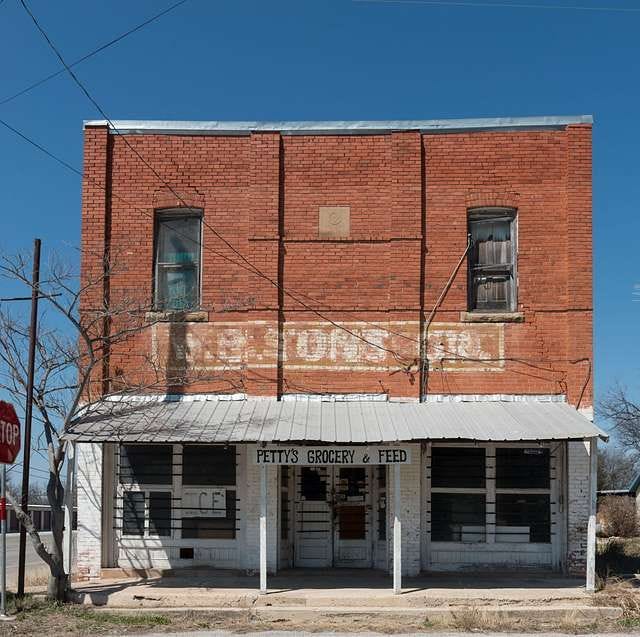
Old, vacant buildings, like this vacant grocery and feed store, is something people in smaller towns and rural America see often. Can we find viable new uses for buildings like this one, and the thousands of others like it? Can small groups of people finding new business ideas for buildings like this one help re-build the economy and local scenes in small towns, mid-sized cities, and the major metro areas? Time will tell. But right now, it’s not looking so good. Public domain photo.
Continued from Simulpocalypse #9- “Conclusion- Part 1”
Right now, late summer of 2025, we have tens of thousands of vacant and abandoned commercial buildings across the United States. A huge percentage of these buildings will drop further in value over the next two to five years. This will be happening as residential real estate values decline in much of the country, particularly in the West and the South. All of this is happening in a slowing economy and very likely a serious recession. The declining values of all these buildings, and those that become vacant in coming months and years, will have a dramatic series of ripple effects.
What will certainly be the most widespread effect of these tens of thousands of vacant and abandoned buildings will be the loans on all of these properties. The crises these failing loans cause will have a national effect on the banking system itself. When businesses of any size really struggle, eventually they have trouble paying the lease or mortgages on their buildings. Businesses that lease space will reduce the space they rent, leasing less office, retail, or industrial space, when their current contract is up. For the building owners, this means they have buildings with higher vacancy rates, and sometimes fully vacant buildings. Then the building owners have a harder time paying their loan payments on the building.
On top of this growing problem, came the higher interest rates beginning in 2021 and continuing beyond. Many commercial buildings have interest-only loans, and they roll over those loans every few years. When those loans needed to roll over, between late 2021 and 2025, the new loans were at interest rates often 3% or more higher than the old loans. So monthly mortgage payments often doubled, or even tripled, for building owners over the last 3 to 4 years. This means that, coming out of the pandemic, many building owners had less money coming in from rents. At the same time, they had much more money going out to pay their building loans, because of the higher interest rates. Since 2022 and 2023, more and more building owners, in industrial, retail, and office buildings, have found it harder to keep up with payments on their buildings. It’s been a really tough environment for a lot of commercial building owners over the last few years, from the small time operators up to the largest corporate landlords.
All of those loans are either owned by individual banks, or bundled with lots of other commercial building loans into CMBS mortgage bonds. If the loan is owned by a mid-sized regional bank, the bank doesn’t want to foreclose on the loan, because it doesn’t want to take possession of the building. Banks exists to provide financial services, not to own and manage a commercial buildings that are already struggling to find tenants.
There are so many commercial buildings struggling, that the banks simply couldn’t take the write-offs on all of these loans, and stay in business. The banks are definitely not suited to own and manage dozens of buildings that are declining in value. So all of these buildings, particularly the small and mid-sized buildings, are putting stress on hundreds of banks that already have enough problems in the current economic conditions.
Now, if the loan on a building was bundled with lots of other loans into a CMBS mortgage bond, then the property owner’s struggles to pay the loan make that bond a little bit less valuable. These bonds were split up into pieces, and those pieces were sold to lots of major investors. If enough loans in a single bond can’t make their payments, then the bond itself drops dramatically in value. This was a big part of the problem with subprime borrowers and residential mortgage bonds (MBS or CDO’s) in 2008, in The Great Recession (aka the GFC). The classic “Jenga tower scene” from the movie, The Big Short, explains this complex idea really well, in a few minutes.
Ultimately, there will be enough loss of value of commercial buildings to create a crisis in lots of banks and in many CMBS bond investments. A crisis will occur. A BIG crisis. There are so many pieces of properties involved nationwide, that no one is sure what to do. The entire commercial real estate industry has been praying for interest rates to go down, and for the U.S. economy to find true, sustained growth, and go up, for a couple of years now. Neither one has happened.
One piece of good news is that The Fed (U.S. Federal Reserve) will very likely start lowering interest rates again this month, September 2025. The bad news is, it will take them at least a year, probably more, to get interest rates super low (when the Fed Funds rate is under 1%) again. Then it will take 12 to 18 months for the full effects of those rate cuts to begin to take effect in the U.S. economy. That means that the real effects of falling interest rates won’t be felt until 2027 and into 2028. The worse news is that the lowering of interest rates by The Fed may not have near the effect it had in previous rate cutting cycles, because of the huge U.S. debt load, soaring U.S. deficit, and other current factors. The even worse news is that there is no sign of true economic growth in the U.S. economy since The Great Recession, 16 plus years ago. Most of what appeared to be economic growth since 2008 was actually newly created money being pumped into the economy through a series of bailouts. New money creation creates the illusion of economic growth… for a while. It only becomes true economic growth if businesses take that money, invest in R&D, create new products and services, and create new markets. Instead, the major companies usually just take the money and buy their own stock back, which boosts their stock price.
So what does all this mortgage and economic mumbo jumbo actually mean to everyday people living in cities across the United States? Whatever you think the causes are in your region, nationwide we have far more square footage of industrial, warehouse, retail, and office real estate than we need. There will be a lot more commercial real estate spaces becoming vacant in the next three or four years, as leases expire, and businesses large and small reduce the size of their physical operations.
While I don’t like this YouTube channel, because of its heavy anti-California P.R. spin, this interview, particularly the last few minutes of it, with commercial real estate insider David Marino, explains how this all is playing out in 2025 and beyond.
So… this double post, #9, is chock full of negativity about commercial real estate, banking, and the U.S. economy. Is there any upside to this apparent nightmare that I’m calling the Simulpocalypse? Yes. There is. Actually there’s a gigantic potential upside for motivated and resourceful business people all across the United States.
Over the next few years, we will see a lot of commercial buildings selling at bargain basement prices. The current owners will just want to escape many of these buildings. Some of those buildings may simply wind up abandoned. The banks don’t want these buildings, they have enough troubles already, coming out of the pandemic and the crazy times since. The mega-sized commercial real estate developers will have dozens of huge buildings and massive complexes to pick from, to find properties at bargain prices, to redevelop in the coming years. They won’t care about the thousands of smaller buildings that will also be vacant. Most of those thousands of smaller buildings nationwide will present opportunities to local and regional business people as the values of these buildings drop, precipitously, in some cases. When a building suddenly costs 40% to 80% less to rent or buy, a whole series of new possibilities open up to adapt that building for some new kind of business or social purpose.
I truly believe that there are people in every town and city that have ideas for businesses, organizations, or other types of uses for many of the unused and vacant buildings in their area. Most of these people with ideas don’t have the experience, the money, the business skills, or the confidence to take over a property and make something completely new out of an old building. They can’t do it all by themselves. But I believe that those resources are there in every single town, city, and large metro areas.
It may take a group of people coming together, pooling different ideas, resources, and expertise, to do the small scale adaptive reuse projects that the towns and cities of the United States truly need. All the pieces are there, somewhere, like a puzzle, after someone spilled the box of puzzle pieces all over the floor. It would be to the benefit of towns and cities everywhere, and to the country at large, to find these different people, and bring them together. We need hundreds, even thousands, of small adaptive reuse projects, to re-imagine all these vacant buildings. A nationwide movement to find viable uses for as many of these old buildings as possible would be a great boon to the entire country.
Back to the original question that this series of posts has planted in my mind. How can we find viable new uses of as many of these under-used and vacant buildings as possible? Answering that question is something we need to do, with as many people as possible involved with in the next several years. Look around your area. Do you have any ideas for the empty buildings in your area? What would it take to make one of those ideas a reality? Just think about it… that’s the place to start.
This Simulpocalypse series of posts is, by no means, meant to be the end all and be all explanation of the current commercial real estate crisis in the United States. This series started out as a look into the empty buildings I’ve seen that I, personally, would like to turn into a cool art studio/gallery/skatepark/bikeparks. That’s just one of my personal dreams. It also started with me noticing in videos how many abandoned locations truly look post-apocalyptic, in the U.S. today. There have been many surprises for me along the way, as I wrote these nine posts. I’ve lived 28 years of my life in Southern California, I had absolutely no idea that there was an entire abandoned military base (the former George AFB), for example, that looks like a gigantic zombie apocalypse movie set, in SoCal.
My pointing in writing this series is to spark the interest of other people in this large issue, and inspire further exploration on your part. The Simulpocalypse series is meant as a starting point, not an end. Thanks for reading. Now go explore…
There are no paid links in this post.
Back to Simulpocalypse Post #1